
Transforming Canadian Provincial Health Access
Overview
The Client
A Canadian provincial health authority responsible for the delivery and management of publicly-funded health services to over 150,000 citizens.
The Digital Modernization Objective
The client’s mission was to establish a trusted, scalable, and user-centric digital environment that would enable citizens to access provincial health services with ease, trust and confidence.
The Problem: Why Modernization Was Critical
The client faced a complex technological landscape characterized by fragmented, siloed, and non-standardized health data. This fragmentation created significant barriers:
-
Data Silos: Health information was scattered and inaccessible across disparate systems lacking interoperability, which impeded clinical decision-making.
-
Provider Constraints: Healthcare providers struggled to obtain a comprehensive view of a patient’s health record, limiting the quality of timely care.
-
Secure, Centralized Access for Citizens: Citizens were unable to use a centralized platform that could host their records and complete identity verification processes.
Urgency Drivers: The shift for modernization was accelerated by the 2020 pandemic, which created an immediate need for streamlined, timely access to immunization records. Furthermore, the province faced mounting pressure to minimize the costly duplication of clinical data across multiple legacy systems and to modernize the entire provincial digital health ecosystem.
Strategic Objectives
To resolve these challenges, the client established several high-priority objectives:
-
Centralized FHIR® Repository: Build a provincial FHIR-native data repository that consolidates disparate source systems into a common standardized data model, using APIs for authorized exchange.
-
Digital Identity Platform: Establish a secure, patient-facing platform for account creation and rigorous identity verification.
-
Identity-to-Record Linking: Implement advanced authorization logic to ensure users are accurately connected to their specific health records.
-
Multi-Level Proofing: Integrate validation for provincial documents (health cards, driver’s licenses) to establish a high-assurance trust layer for patient identity.
The Made-in-Canada Solution: Smile and IDENTOS
IDENTOS provides the secure digital identity and access layer for the provincial ecosystem integrated with the Smile OmniVera data foundation. IDENTOS solutions include the Authorization Server (AS), Identity Verification (IDV), Identity Store (IDS), and Wallet — together enabling citizens to verify who they are, log in with confidence, and control access to their own health information.
The solution architecture leveraged a powerful synergy between two Canadian companies solving the problems of data connectivity and patient care — Smile Digital Health and IDENTOS. The approach started with the most urgent requirement, the immunization records, and later expanded to include broader data sources for a variety of needs.
-
OmniVera: This data foundation transforms fragmented, non-standardized data from disparate and legacy systems into a structured and standardized FHIR repository. Provincial autonomy and sovereignty is maintained as citizen data remains in the Canada. Upon this unified source-of-truth computable data, all downstream programs and initiatives now utilize this comprehensive and validated high-quality data source. The Province gains an auditable foundation designed to be extendable to new services without needing to rebuild the underlying infrastructure.
-
IDENTOS Platform: This identity and access layer establishes citizen’s identity, verifies them, and links them to the correct health record. It uses policy-based access control to manage this across the health and government ecosystem. Citizens are able to manage their consent preferences, as well as see and control who has access to their records.
Synergy: Together, the technologies resolved and extended the client’s objectives. Citizens could verify their identity using provincial documents, which when linked deterministically by the system, ensured the verified identity was paired with the correct health record. This architecture integrates high-assurance proofing directly with the data foundation, providing the technical architecture and a robust framework for auditability, consent, and secure data sharing.
Benefits and Impact
The implementation resulted in immediate, measurable improvements for the Province and its citizens:
-
Adoption and Trust: 54.7% of users who created an account successfully completed identity verification, far exceeding the 13%1 Canadian average for electronic access. Furthermore, 79.0% of verified users immediately linked their Health Cards, demonstrating trust and intent to engage with their health data.
-
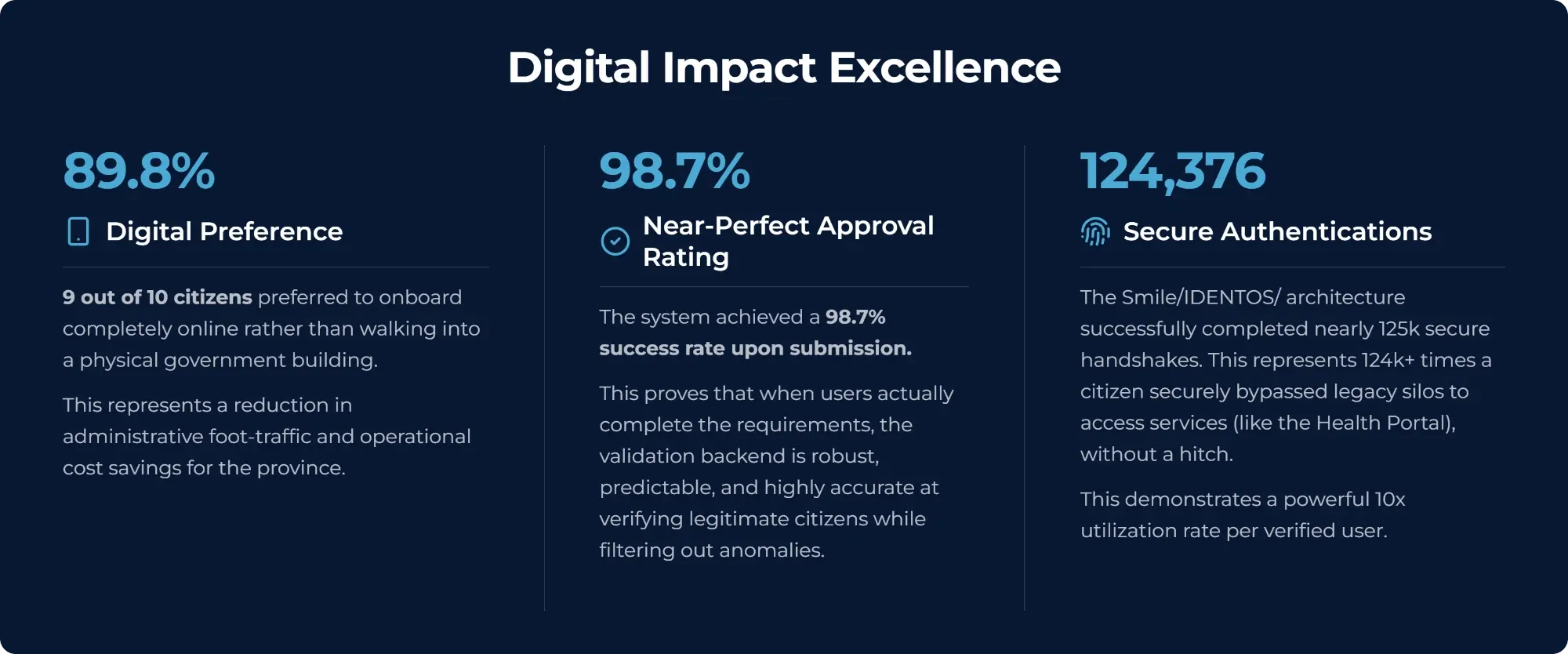
Digital Preference: 9 out of 10 citizens (89.9%) opted to onboard entirely online, reducing physical foot-traffic and operational overhead.
-
Engagement: The Smile/IDENTOS architecture successfully completed over 124,000 secure authentications, allowing citizens to bypass legacy silos. Each verified user logged in an average of 10 times demonstrating sustained platform engagement and value.
-
Operational Excellence: The system demonstrated a 98.7% approval rate upon submission, validating the robustness of the backend architecture.
Strategic Value
The Smile/IDENTOS solution architecture is the foundation for a modern computable health data ecosystem. The province is now extending this transformative initiative to include:
-
Adding additional clinical domains without significant technical rework and administrative effort
-
Making the unified data repository available for both Patients and Providers across the province via their respective health portals
-
Developing a provincial Patient Summary (PS) which enables secure data sharing across clinical boundaries, and other provinces
Speak to an Expert
See how Smile can power your modernization strategy with clarity,
consistency, and confidence.
