$10M Operational Benefit from FHIR®-Native Clinical Intelligence
3,000 Patients | 33% Shorter Stays | 50% Less Complications | 95% Less Admin Effort
Overview
The Client
A large US Payer and healthcare delivery organization operating a multi-state network of primary and specialty clinics.
The Challenge
Fragmented EHRs and inconsistent CDS made it difficult to deliver standardized, evidence-based care across acquired clinics.
The Solution
Smile Digital Health authored reusable, computable CPGs on the OmniVera data foundation, using HL7® FHIR and CQL to deliver near real-time clinical decision support across the organization's care network.
The Challenge
As the client acquired primary and specialty clinics across the US, it inherited multiple EHRs and fragmented clinical decision-support systems where clinical definitions, data fields, values, and decision logic varied from site to site. Clinicians and staff therefore spent significant time manually gathering and reconciling information before making care decisions. The organization needed a way to:
- Standardize clinical knowledge across all care settings,
- Deliver evidence-based clinical recommendations in real time,
- Integrate with existing EHR workflows, and
- Reduce the administrative burden on clinicians.
Rather than build this capability entirely in-house, the organization partnered with Smile Digital Health to create computable, reusable clinical practice guidelines (CPGs). They chose this model because they had limited in-house expertise and technical resources to build high-quality computable CPGs.
The Solution
Smile transformed established clinical practice guidelines into reusable, computable CPGs, enabling the organization to deliver consistent, evidence-based recommendations across its care network.
In contrast with market CPG recommendation solutions, Smile takes dense narrative specifications created by expert agencies, like ADA (American Diabetes Association), AHA (American Heart Association) and NCI (National Cancer Institute), and faithfully represents those established treatment guidelines.
The CPGs were authored using Smile’s FHIR-native and CQL engine, and integrated into the client's enterprise clinical platform. This allowed the same clinical logic to be applied across any EHR environment without recreating proprietary rules for each system. These reusable and computable CPGs continue to work with the client’s common computable enterprise-level platform today.
The resulting CPGs were then made available in near real-time at all points-of-care in the client’s network. Since the CPGs are not locked into proprietary authorship, the client can update and scale them across clinics, regardless of which EHR system is being used.
Technology Behind the Solution
FHIR Standardizes Data. CQL Standardizes Clinical Logic.
Together, FHIR and CQL create the foundation for interoperable, computable clinical decision support. FHIR standardizes how clinical data is represented and exchanged, while CQL contextualizes clinical knowledge and turns it into reusable, executable logic that is both human- and machine-readable.
This combination enables data to be ingested, normalized and queried consistently across systems, reducing variation, accelerating clinical insights and eliminating the need to recreate clinical logic for each environment.
The result is standardized organizational data, upon which evidence-based clinical decision support is delivered at the point-of-care, integrating seamlessly with any EHR. CDS recommendations are auditable, scalable and delivered in near real-time.
Results of Implementing Smile’s Solution
Smile's Knowledge Engineering team authored CPGs built from established best practices for colorectal cancer post-surgical care. The computable CPGs were applied consistently across a group of 3,000 patients under a team of 8 surgeons, often combining multiple CPGs within the care pathways.
With CDS available at the point of care, the care team achieved:
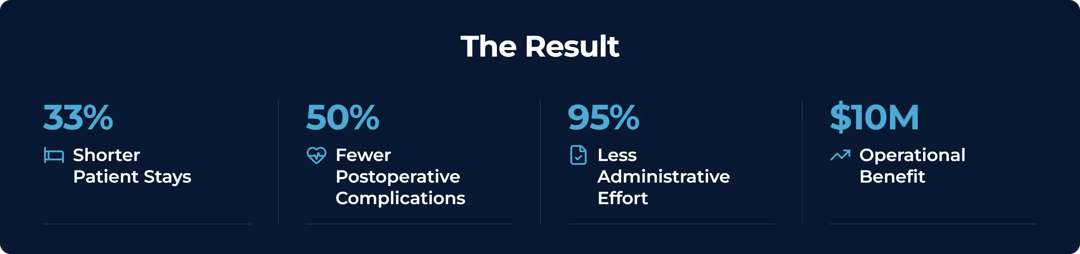
- A 33% reduction in patient stays (an average of one day per patient), freeing up capacity for more visits, smoother clinic workflows, and increased revenue.
- A 50% drop in post-operative complications, which improved patient satisfaction and cut costs tied to non-reimbursable corrective procedures.
- A 95% drop in administrative effort as clinicians no longer needed to start shifts early, or hire extra staff to track down records.
Combined, these gains delivered a $10M operational benefit.
As an early adopter of Smile's technology, the client also continues to benefit from:
- Rich CPG libraries that combine clinical language, established treatment protocols, and structured logic, forming the foundation for defensible and scalable AI-generated analytics.
- De-risking quality reporting, since quality measures run on the same source data as the CPG specification itself.
How Smile Leads the Way
Smile Digital Health is an award-winning company, with decades of expertise defining and implementing HL7 open standards in healthcare globally.
- Award-winning: Winner of Deloitte's Technology Fast 50 and Fast 500 awards for over 5 consecutive years.
- Maintainer of HAPI FHIR: the world's leading open-source FHIR reference implementation.
- Custodian of CQF Ruler: a decision-support service that runs quality measures on clinical reasoning.
- Active Contributors to multiple Implementation Guides (IGs), including US Core CPG, CDS Hooks, CPG, and QM.
- Primary contributor to establishing the CDS standardization process into FHIR.
- 190+ real-world FHIR data transformation and modernization implementations worldwide.
- 30+ US Payer deployments touching 110 M+ American lives
The Next Decade of Clinical Quality
Industry standards are the foundation for solving systemic problems. When ISO (International Organization for Standardization) took shape after World War II, it gave nations a shared, standardized way to coordinate processes, materials, and quality guidelines, enabling new levels of specialization and efficiency that accelerated industrial progress for decades.
Healthcare is undergoing its own version of that shift. Standards bodies like HL7 (Health Level Seven International), along with governance and accreditation organizations such as HITRUST and Drummond, are building the trust and interoperability layer that is essential for healthcare to modernize at scale.
FHIR is well understood across US healthcare. The challenge is execution — turning a standard into clinically intelligent data that runs reliably across an entire enterprise. FHIR with CQL unifies structured data with standardized clinical reasoning, and allows reusability of this foundation across organizations, without rebuilding data, logic and workflows from scratch for every system and use case. Achieving that requires an architecture built for enterprise scale, capable of supporting hundreds of clinicians querying the same logic simultaneously without duplicating it.
Without a data foundation like this, even well-established CPGs go unused when systems can't deliver them consistently. Adherence to colorectal surgery CPGs can be as low as 29%. The above case study demonstrates measurable benefits in the real-world with a data foundation built for the next decade of healthcare.
While this past decade in healthcare has been involved in building interoperability standards, the coming decade is about what they make possible. This includes, but is not limited to: predictive care gap closures, precision care with value-based outcomes, and AI insights that are more trustworthy because they run on a shared, unified data foundation. A common foundation doesn't just reduce cost and variation, it is what allows quality, compliance, care delivery, and AI-driven insight to scale together, reliably, across an entire organization's Quality Improvement Lifecycle.
Smile’s Commitment to Quality and Compliance

.png?width=300&height=200&name=HD_ISO%2027017%20(1).png)
.png?width=300&height=200&name=HD_ISO%2027018%20(1).png)


Ready for Results Like This?