

Payers today are facing increasing pressure to deliver precision higher-quality care at lower cost. Regulations, such as the proposed and final CMS Rules, and quality accreditation bodies like NCQA are directing the industry towards modernization and interoperability over the next several years. These initiatives impact quality measurement cycles, Star Ratings, compliance initiatives, data ingestion, access and exchange. They serve as the foundation for how care will be delivered appropriately and cost-effectively, without compromising data security and ownership in the decades to come.
This industry shift moves us away from fragmentation of data, formats, and processes, and towards a unified, validated and intelligent data platform. The opportunity here is to establish a fully computable, reusable data architecture that can progressively support the entire spectrum of initiatives from data ingestion to quality, compliance, risk management and eventually, real-time operationalized clinical intelligence.
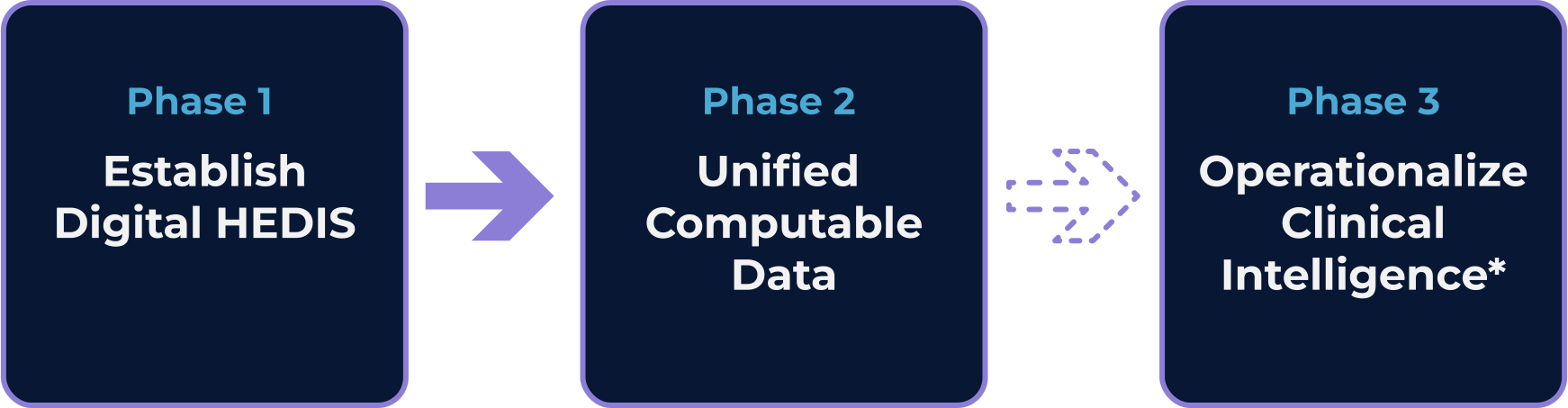
The Quality Modernization journey is a progression in which the same trusted data and computable quality foundation supports increasingly sophisticated use cases, without manual burden, costs, duplication and rework. This progression runs across three phases:
For Payers, the optimal, financially sustainable Digital HEDIS® investment is one that extends and scales across the full quality measurement lifecycle, and holds up as CMS continues to reshape Star Rating economics.
We Are Here
Every Payer is in Phase One right now, which is the run-up to 2030. CMS has set a goal to transition all quality measures to digital by then, and NCQA expects organizations to have fully transitioned to Digital HEDIS by about 2030, depending on market readiness.. For the evolution of Digital HEDIS, a technology vendor alone will not be sufficient. Payers must also address enterprise-wide change management and coordination.

This phase starts with HEDIS workflows, establishing the governance, data, and technology capabilities required to evolve beyond retrospective and hybrid quality processes. It includes:
- Establishing enterprise cross-governance between quality, clinical, IT, security, compliance, operations, and risk management teams
- Ingesting legacy data in any format into a FHIR®-native architecture that returns measure results in minutes rather than in weekly or annual batch cycles
- Creating a trusted, enterprise-wide data foundation using FHIR and CQL open standards for structured data and computable quality logic
- Authoring all HEDIS measures into a validated, deterministic, computable format, starting with the most common or high-value measures
- Establishing a strategy for managing hybrid measures while preparing for the transition to digital measurement
By 2030, Payers will be able to measure HEDIS scores digitally, consistently, and with greater confidence, while building the foundation for what comes next.
Where We Are Going
Phase Two is about extending the Digital HEDIS foundation across all quality programs and use-cases across the enterprise. Payers must ensure that patchworks of vendors do not create new silos across quality programs. Most Payers are currently focused on Digital HEDIS implementations and have not yet evaluated their (potential or chosen) vendor’s ability to extend the data and intelligence foundation across all quality measurement cycles. This phase includes:
-
Validating unified enterprise source data once at source to use across multiple initiatives
-
Authoring and executing custom, state, and jurisdictional digital measures using the same standards-based approach, without paywalls or significant rework
-
Applying computable measures consistently across populations and programs
-
Establishing greater data liquidity, ownership, and autonomy
-
Accessing to population-level insight and analytics
-
Enabling Providers to access and contextualize data for decision support and MIPS reporting
Phase Two may occur in parallel with Phase One, or begin shortly thereafter. This phase delivers Quality as an intelligent, cohesive enterprise capability, rather than a collection of fragmented programs, measures, and workflows.
Today Phase Three* serves as a goal, moving the industry towards fully embedded operationalized clinical intelligence available in real-time at the point-of-care. Once trusted data and continuously executable quality logic are in place, Payers can begin embedding quality intelligence directly into daily operational and clinical workflows, by:
- Identifying care gaps and quality risks continuously, within clinical workflows
- Enabling seamless payer-provider collaboration, using shared data and consistent logic
- Generating actionable member and population insights
- Identifying opportunities to improve performance before they affect quality outcomes
- Supporting clinical decision-making at the point of care
The outcome is a shift towards cost-effective, real-time value-based care, as the quality lifecycle becomes a proactive capability for improving care and outcomes for members and populations.
As early implementers of FHIR and CQL globally, Smile is building toward fully operationalized clinical intelligence as the natural extension of a validated, computable quality foundation.
Note: * Denotes in-development
Next Steps for Payers on the Quality Modernization Journey
The industry direction is towards precision high-value care that is measurable, auditable and cost-effective, delivering positive outcomes. This starts with Digital HEDIS, which directs the industry away from fragmented, reactive and burdensome submission processes.
As pioneers of open standards, FHIR and CQL implementations, Smile Digital Health’s solutions are designed to work with a Payer's existing ecosystem (not a rip-and-replace model), and at whatever phase of modernization they are in. Our expertise spans the technology, quality, clinical, operational, and governance considerations required to move from manual or hybrid measurement toward real-time clinical intelligence.
Our recommendation is to invest time, expertise and budgets into a unified, validated, computable data and logic foundation, built on FHIR and CQL, that delivers a Digital HEDIS solution and extends to other quality and compliance use cases.
Smile OmniQ: Your Quality Foundation
OmniQ provides a unified quality layer that runs logic for Digital HEDIS and custom measures, and clinical intelligence.
Wherever Payers are on their modernization journey, Smile OmniQ builds and supports Payer digital transformation.


Built on a trusted, computable data foundation, OmniQ enables payers to aggregate, calculate, analyze, and operationalize quality measures using FHIR-native data and CQL. The result is a consistent, defensible, and auditable approach to quality that can evolve as a Payer's modernization strategy matures.
A successful investment in digital transformation of quality requires organizations to change how data is governed, how measures are implemented, how quality and compliance teams operate, and ultimately how intelligence is incorporated into care and operational workflows.
Smile brings the technology and implementation expertise together.
